Private market forecasting software for forward portfolio decisions
Commitment pacing determines how much capital to commit, when to commit it, and how those decisions shape future exposure, liquidity, and portfolio construction. TRTL supports commitment pacing by turning allocator-defined assumptions, portfolio history, and current positions into forward cashflow and NAV forecasts.
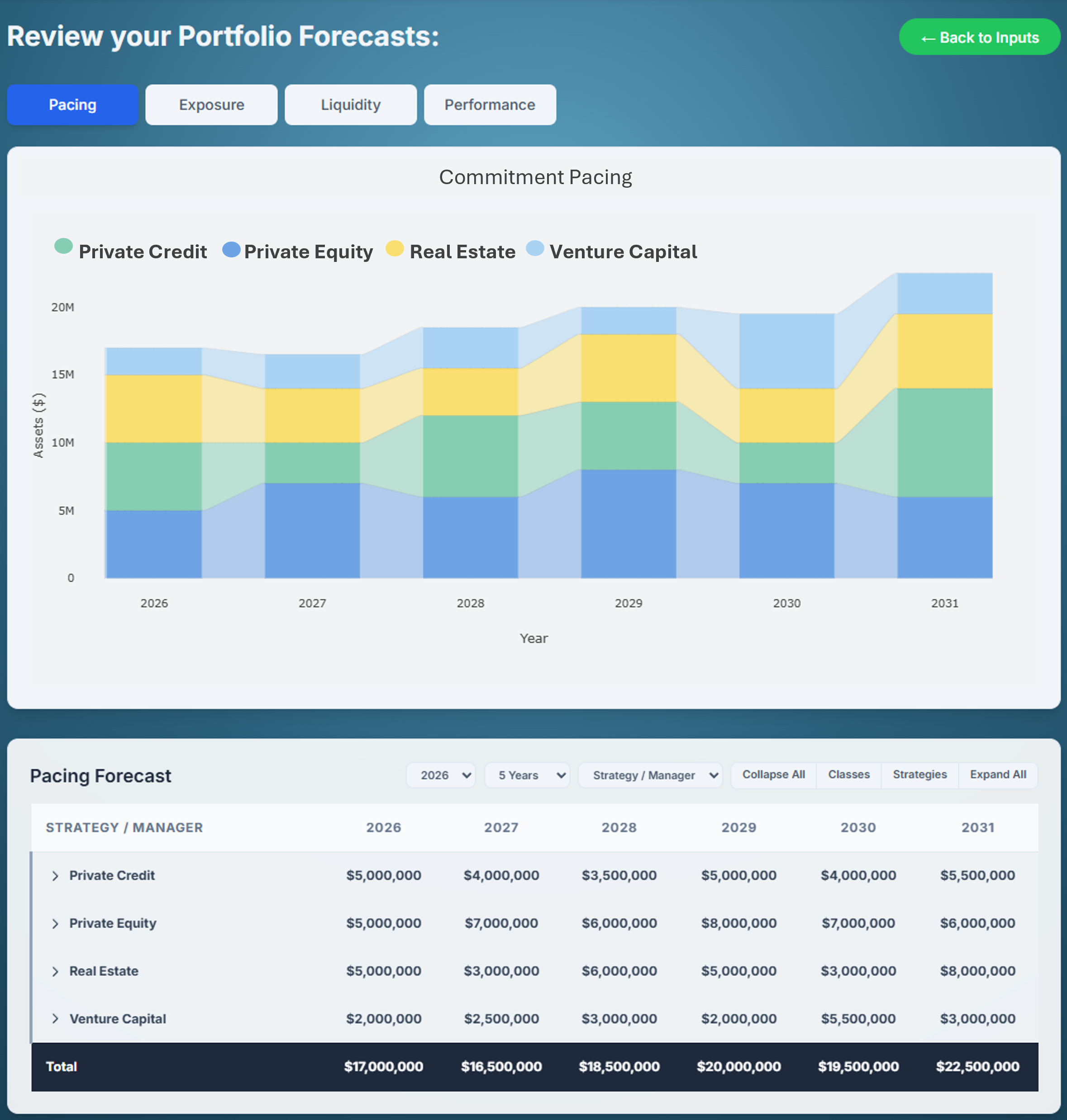
For private equity, venture capital, and broader private market portfolios, commitment pacing is difficult because decisions are made before the future path is visible. Commitments are made upfront while capital is drawn over time, distributions do not follow a fixed schedule, and exposure builds gradually across funds, vintages, strategies, and structures.
A pacing plan that looks reasonable today can create future overexposure, underallocation, vintage concentration, or liquidity pressure if capital calls and distributions arrive on a different path than expected. A credible commitment pacing process needs more than a target allocation. It needs a forward view of how commitments translate into capital calls, distributions, NAV, and exposure over time.
TRTL gives pacing decisions a forward baseline. Instead of treating commitments as an annual budget exercise, allocators can see how different commitment levels change exposure build, funding needs, and portfolio shape over time.
Commitment pacing is not a one-time portfolio construction exercise. Before a commitment is made, pacing helps frame how much capital can be put to work. During portfolio buildout, it helps manage exposure growth and vintage balance. Later, as funds mature and actual results arrive, the pacing plan can be revisited against current liquidity conditions, distribution pace, and future funding needs rather than the original commitment schedule alone.
Pacing decisions affect more than future commitments. They influence liquidity needs, exposure build, allocation drift, and the timing of future portfolio flexibility.
That is why TRTL connects commitment pacing to the same forward path used for liquidity forecasting, exposure management, performance monitoring, and valuation. The goal is not to optimize pacing in isolation. It is to understand the portfolio consequences of today’s commitment decisions.
Pacing is where long-term portfolio construction becomes a decision today. Commit too little, and the portfolio can remain underallocated for years. Commit too much, and the portfolio can face over exposure, vintage concentration, or liquidity pressure after the decision is already locked in.
TRTL helps make pacing more visible and governable by connecting commitment decisions to the forward path they create.