Private market forecasting software for forward portfolio decisions
Performance monitoring in private markets is not just about reporting IRR, TVPI, DPI, or NAV. It is about understanding whether realized cashflows and reported NAV are tracking the expected path. TRTL compares actual portfolio behavior to forward forecasts so allocators can identify drift before outcomes fully unfold.
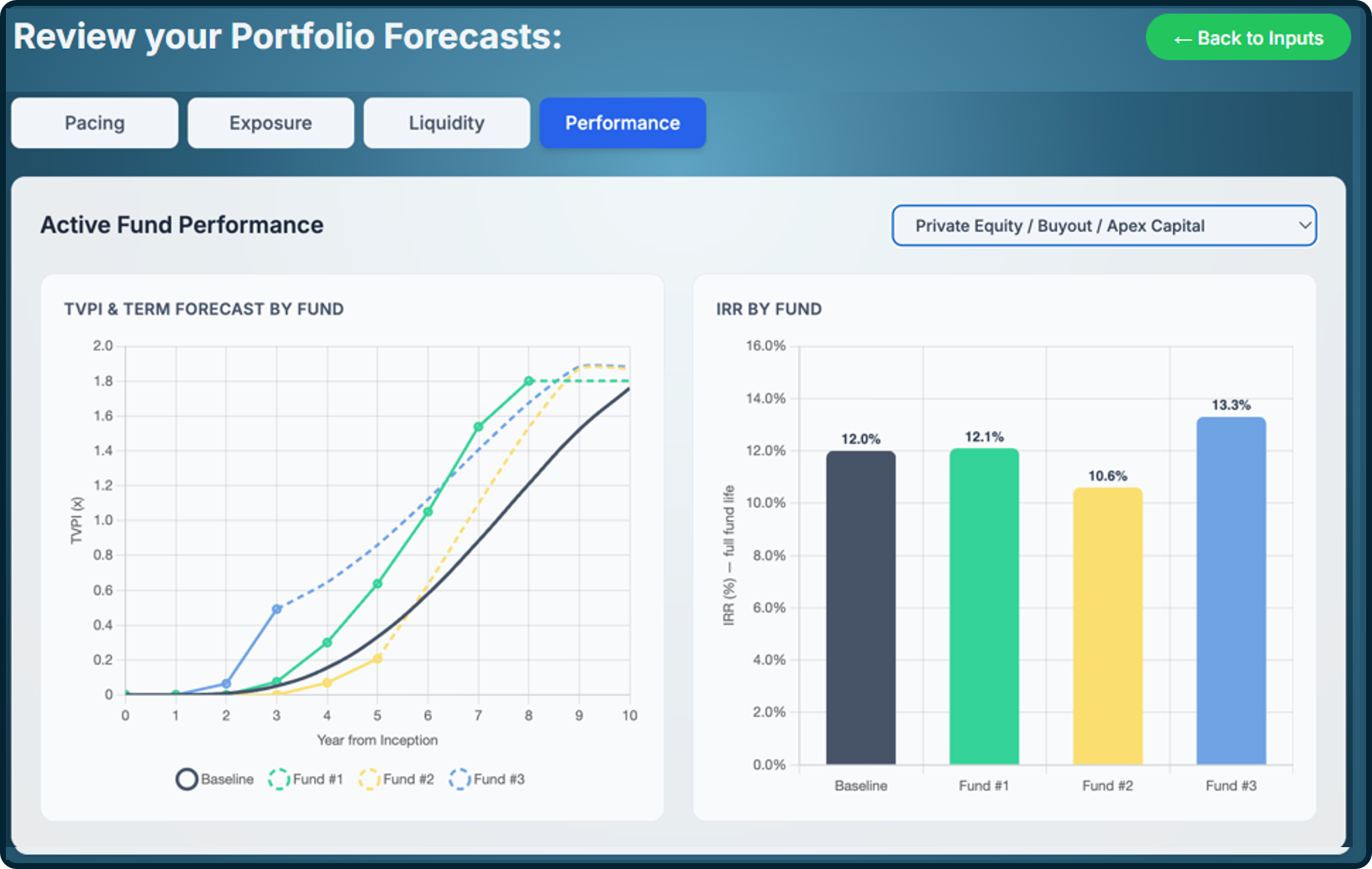
Private market performance metrics summarize results, but they do not always explain how those results are developing. IRR, TVPI, and DPI can show where a fund stands today without showing whether cashflows, NAV, or remaining value are moving in line with expectations.
Reported performance can also lag underlying conditions. A portfolio may be drifting from plan before the divergence is obvious in quarterly reporting.
TRTL turns performance monitoring into a path comparison. Actual cashflows and NAV are compared against the expected path, then used to update the forward view.
Performance monitoring evolves over time. Early in a fund’s life, monitoring may focus on deployment pace and initial valuation changes. As funds mature, it shifts toward distribution timing, realized returns, and the relationship between NAV and cashflows.
Performance monitoring is most useful when it changes the forward view. Slower distributions, faster deployment, NAV drift, or changes in IRR, TVPI, and DPI can alter liquidity conditions, exposure build, pacing capacity, and valuation decisions.
TRTL ties realized results back to the expected portfolio path, so performance can be interpreted as a signal for what may need to change next.
Performance is not just an outcome. It is a signal. Without a forward view, performance is often evaluated after the fact, when decisions are harder to change. With a forward framework, allocators can identify drift earlier and understand how today’s realized behavior changes the path ahead.
TRTL helps turn performance monitoring into an early-warning process, connecting realized cashflows, NAV, IRR, TVPI, and DPI to the decisions they should inform next.