Private market forecasting software for forward portfolio decisions
Scenario analysis and valuation in private markets require more than a single reported NAV. They depend on seeing how remaining cashflows change under different assumptions. TRTL generates forward cashflow and NAV paths that can be tested, compared, and valued across scenarios.
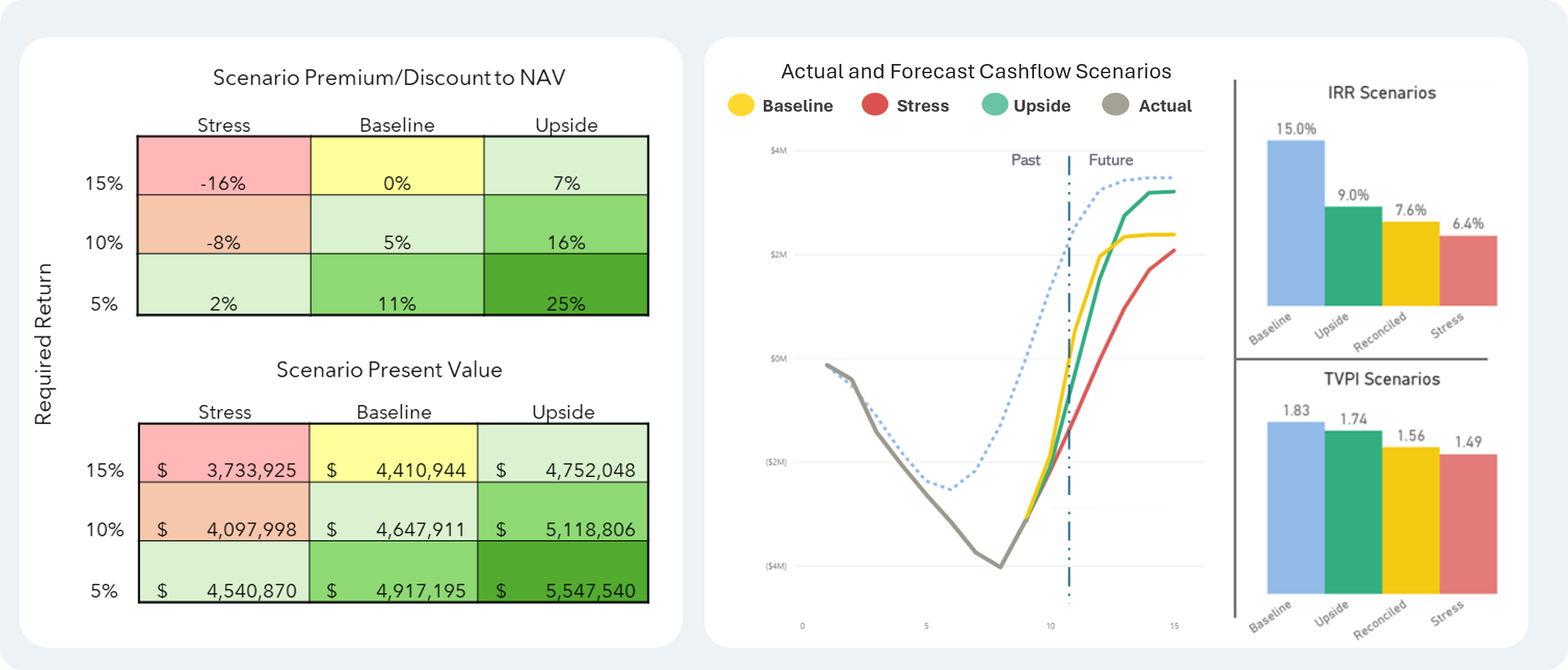
Private market valuation is often treated as a point estimate. In practice, it depends on the timing, magnitude, and risk of future cashflows. Reported NAV is a starting point, but it does not fully capture liquidity, opportunity cost, or the range of outcomes implied by different realization paths.
Scenario analysis is difficult because small changes in timing, distributions, or performance assumptions can change the decision. A hold, sell, pacing, or reallocation choice can look different once the remaining path is made visible.
TRTL connects scenario analysis and valuation to the same forward cashflow path. Instead of valuing a static NAV point, allocators can compare how different assumptions change future value and decision tradeoffs.
Scenario analysis and valuation are relevant throughout the investment lifecycle. Before commitments are made, they help evaluate potential outcomes under different assumptions. During portfolio construction, they help compare pacing and allocation strategies. As funds mature, they help assess whether to hold, sell, or reallocate based on the expected remaining path.
TRTL supports these decisions by maintaining a forward view that can be adjusted and compared over time.
Scenario analysis and valuation depend on the same underlying drivers as performance, liquidity, and exposure. Distribution timing affects liquidity. Performance changes expected value. Pacing decisions shape exposure and capital deployment.
TRTL ties scenario analysis and valuation to the remaining portfolio path, so hold, sell, pacing, and reallocation decisions can be compared on a common forward basis.
Valuation is a function of assumptions about future cashflows. Without scenario analysis, decisions rely on one view of the future. With a forward framework, allocators can compare alternative paths, understand tradeoffs, and value what comes next.
TRTL helps make those assumptions explicit, so valuation becomes something allocators can test, compare, and govern rather than a static number to accept.