Private market forecasting software for forward portfolio decisions
Exposure management is the process of understanding how private market commitments become actual portfolio allocation over time. TRTL forecasts how NAV, capital deployment, and portfolio concentration evolve across funds, vintages, strategies, and structures.
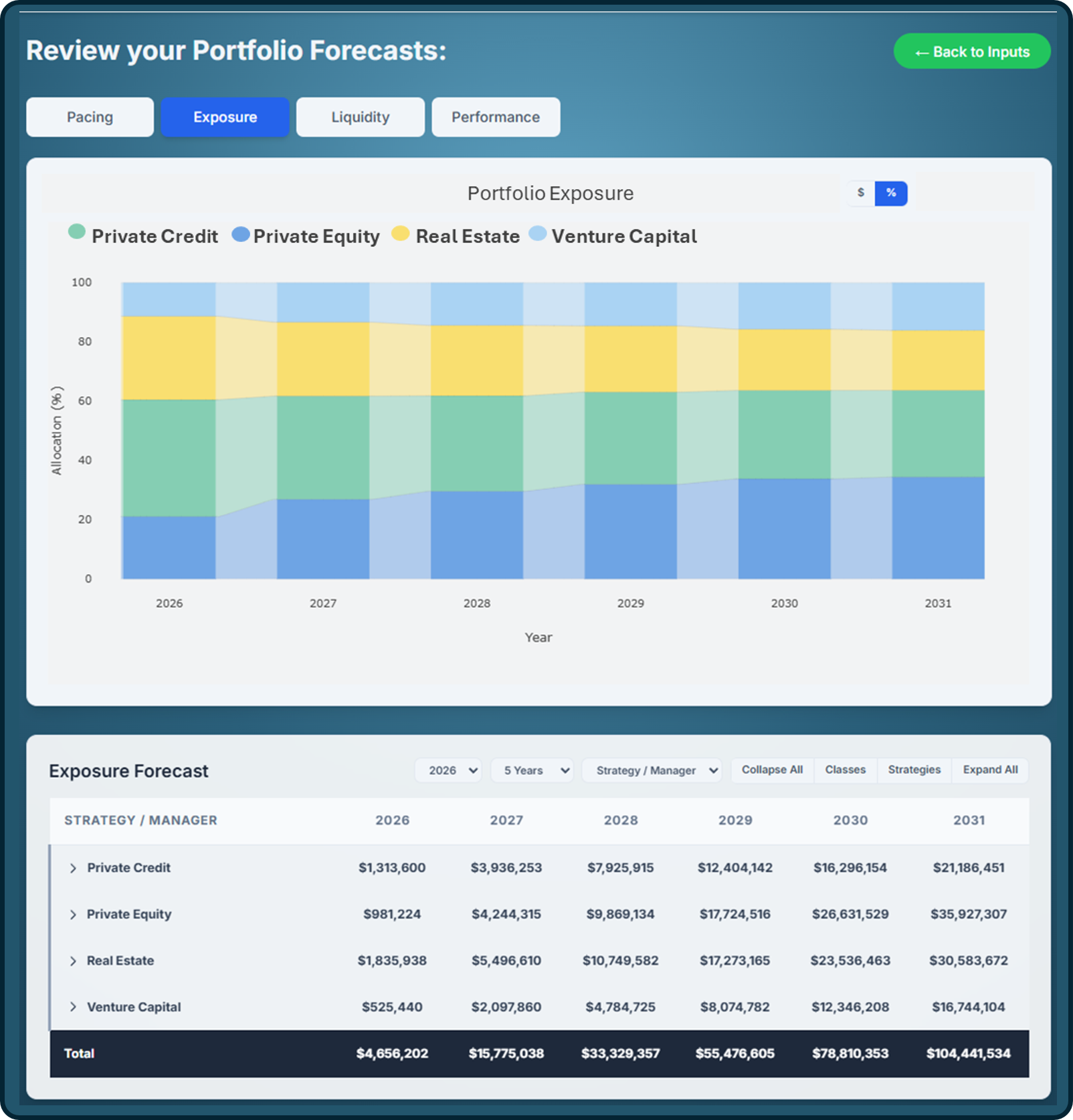
Private market exposure builds gradually. Commitments are made upfront, capital is drawn over time, and NAV evolves as assets are deployed, marked, and realized. Unlike liquid portfolios, exposure cannot be reset quickly through simple rebalancing once commitments are in place.
For private equity and broader private market portfolios, this creates a visibility problem. A portfolio can appear aligned today while future deployment, NAV growth, or distributions push it toward overexposure, underallocation, or unintended concentration.
TRTL gives allocators a forward view of exposure instead of a point-in-time allocation snapshot. It shows how today’s portfolio and commitment plan translate into future NAV, target allocation, and concentration.
Exposure management is relevant throughout the investment lifecycle. Before commitments are made, it helps determine how capital should be allocated. During portfolio construction, it helps manage exposure build and diversification. As funds mature, it helps assess whether the portfolio remains aligned with target allocation and risk objectives.
Exposure management is closely linked to commitment pacing and liquidity forecasting. Pacing decisions determine how exposure builds, while capital calls, distributions, and NAV growth shape how allocation evolves over time.
TRTL connects those drivers into a forward exposure view, helping allocators monitor exposure as it forms rather than only after it appears in reported NAV.
Exposure is easy to measure after it exists and harder to govern before it forms. By the time over exposure, under allocation, or vintage concentration is obvious, the underlying commitments may already be locked in.
TRTL helps allocators see how exposure is forming ahead of time, so allocation decisions can be managed before the portfolio drifts too far from plan.